No new fees for medical devices
New levies on medical devices are a political «own goal» – especially in view of the already challenging economic and supply landscape.
What’s the issue?
In recent years, Swissmedic, the Swiss Agency for Therapeutic Products, has regularly generated surpluses of millions of Swiss Francs. In 2023, the agency reported revenues of around 115 million Swiss Francs and accumulated reserves exceeding CHF 100 million. According to the Federal Council's 2023 report, these reserves would enable the agency to cover expected shortages in the future, notably due to rising IT costs.
In 2024, however, Swissmedic recorded a loss of 23.4 million Swiss Francs. According to a press release issued on 25 November 2025, the institute expects deficits to continue into 2025, and onwards. As part of the planned revision of the Therapeutic Products Act (3b), a regulatory fee on medical devices is to be proposed, which is expected to generate annual revenue of CHF 20–25 million.
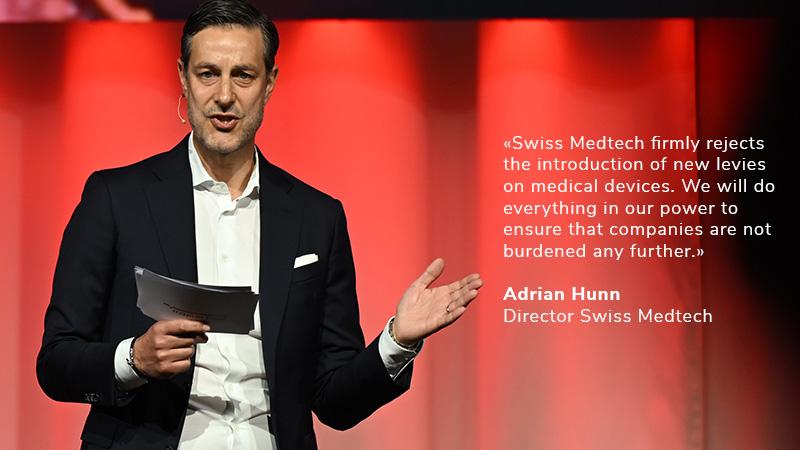
Swiss Medtech’s Position
Swiss Medtech has four main reasons to firmly reject the plan for new supervisory fees: Firstly, it is not acceptable to force private industry to pay for the budget shortfalls of a federal agency. Secondly, focusing only on fees without considering the corresponding VAT percentages is misleading. Thirdly, new levies represent a political «own goal» in view of the already existing challenges. Fourthly, the additional costs would worsen the current supply shortages of medical devices.
Swiss Medtech therefore demands a halt to the imposition of new supervisory fees on medical devices. Instead, available reserves of the Swissmedic Therapeutic Products Agency should be utilised and the causes of the deficits addressed. This includes, specifically, an independent and transparent efficiency review of Swissmedic's cost management performance.
Arguments
Regulatory agency deficits should not be passed on to private industry
The financial problems faced by Swissmedic, the Swiss Agency for Therapeutic Products, first and foremost necessitate a comprehensive internal review. As a federal agency with its own budget and clearly defined mandate, it alone is responsible for its financial affairs. Deficits arising within a short period after years of healthy reserves is not a natural occurrence, but rather a management issue. New regulatory levies to cover the deficit shift responsibility from the authorities to the medtech industry. This is not justifiable from a policy perspective.
Equal treatment? Then be consistent!
At first glance, it seems contradictory that medicines are subject to a supervisory fee, but medical devices are not. In fact, the regulation is reasonable as medical devices are taxed at the regular 8.1% VAT – which alone contributes approximately 600 million Swiss francs to the federal treasury each year. Medicines, on the other hand, are subject to an extremely reduced rate of 2.6% value added tax. If supervisory fees are to be applied to medical devices, then medicine and medical devices must be treated equally in all regards. Focusing solely on the fees fails to address the whole picture.
New levies are an act of self-sabotage in terms of business location policy
Political leaders must create reliable framework conditions given the already high burdens on the medtech industry: the termination of the trade agreement with the EU (MRA), the implementation of the European Medical Device Regulation (MDR), the strong Swiss franc, and the ongoing US tariffs. New supervisory levies will be counter-productive in terms of business location policy – they will further increase the financial burden on companies and weaken Switzerland's position as an attractive location in a highly competitive international market. Virtually no other country has a comparable supervisory levy on medical devices.
More fees means fewer medical devices
The supply shortage of medical devices is already alarmingly high. Five years ago, Switzerland introduced stricter import restrictions for medical devices. As a result, around 15% of medical devices have disappeared from the Swiss market. New supervisory fees would intensify this trend, as they would reduce the economic attractiveness of supplying the small Swiss market. Ultimately, Swiss patients are the ones to suffer. Although Switzerland's purchasing power is amongst the highest in the world, the country is losing relevance as a sales market for medical devices. Regulation must not create or contribute to supply shortages.